Building a functional API is one thing; designing one that developers enjoy using is another. In today's interconnected systems, a well-designed API is a powerful product, a crucial business asset, and the foundation for innovative ecosystems. Yet, many teams fall into common pitfalls, creating APIs that are confusing, inconsistent, or insecure.
This guide presents eight practical areas to review. They are design considerations rather than universal rules: the correct interface depends on the protocol, domain, clients, threat model, compatibility commitments, and operational constraints.
Drawing on insights from our work at Data4AI and industry leaders, these practices will help you build APIs that are not only powerful but also predictable, scalable, and a pleasure to integrate. Let’s dive into the principles that separate a good API from a truly great one.
1. RESTful Design Principles

Adhering to RESTful design principles is a foundational best practice for creating scalable, maintainable, and predictable web APIs. REST, or Representational State Transfer, is not a protocol but an architectural style that leverages standard HTTP conventions. It treats application data and functionality as a collection of resources, each uniquely identified by a URI (Uniform Resource Identifier). This approach makes APIs intuitive for developers, as they can interact with resources using standard HTTP methods like GET, POST, PUT, DELETE, and PATCH.
REST’s stateless constraint means each request contains the information needed to understand it and that the server does not rely on stored client-session context between requests. It does not mean a REST service stores no state: resource state, credentials, authorization policy, idempotency records, caches, and operational data can still exist on the server.
Actionable Implementation Tips
To effectively implement RESTful principles, focus on consistency and clarity in your endpoint design. This predictability is a key reason why industry giants like Stripe and GitHub use RESTful APIs to power their platforms.
- Use Nouns for Resource URLs: Resources should be identified with nouns, not verbs. The HTTP method (GET, POST) specifies the action.
- Actionable Example: To fetch order details, use
GET /api/v1/orders/123instead ofGET /api/v1/getOrderById?id=123.
- Actionable Example: To fetch order details, use
- Employ Plural Nouns for Collections: Use plural nouns to denote a collection of resources, which makes the API structure more logical.
- Actionable Example: Use
/usersto represent the collection of all users and/users/42to represent a specific user. This creates a predictable hierarchy.
- Actionable Example: Use
- Leverage HTTP Status Codes Correctly: Use standard HTTP status codes to communicate the outcome of an API request. This provides immediate, standardized feedback to the client.
- Actionable Example: When a new user is created via
POST /users, respond with a201 Createdstatus code and include the location of the new resource in theLocationheader, likeLocation: /api/v1/users/43.
- Actionable Example: When a new user is created via
2. Consistent and Predictable URL Structure

A well-designed URL structure is a cornerstone of effective API design best practices, as it creates an intuitive and discoverable interface for developers. It involves establishing logical, hierarchical patterns for endpoints using consistent naming conventions. This predictability means developers can often guess endpoint locations without constantly referring to documentation, significantly speeding up integration. A clear URL structure acts as a reliable contract between the API provider and its consumers.
The primary benefit of a consistent URL structure is the enhanced developer experience. When resources are organized logically, the API feels more like a well-documented library than a black box. This structured approach also complements other architectural concepts, like those found in modern data platform design, where clarity and organization are paramount.
Actionable Implementation Tips
To implement a predictable URL structure, prioritize clarity and consistency in every endpoint. Major platforms like Salesforce (/services/data/v54.0/sobjects/Account/) and Slack (/api/conversations.history) exemplify this by creating resource-oriented paths that are easy to understand and use.
- Use Kebab-Case for Readability: Use hyphens (kebab-case) to separate words in URL segments, as it improves readability and is URL-friendly.
- Actionable Example: Define an endpoint for user profiles as
/api/v1/user-profiles/instead of/api/v1/userprofiles/or/api/v1/user_profiles.
- Actionable Example: Define an endpoint for user profiles as
- Keep URLs Short and Descriptive: URLs should be concise yet meaningful enough to describe the resource without ambiguity.
- Actionable Example: LinkedIn's API uses
/v2/people/{person-id}/connectionswhich is clear and to the point.
- Actionable Example: LinkedIn's API uses
- Use Query Parameters for Selection: Reserve the path for identifying resources and use query parameters for filtering, sorting, searching, field selection, and pagination. Model domain actions deliberately rather than hiding unsafe state changes behind a GET query parameter.
- Actionable Example: To get a list of active articles sorted by publication date, use the endpoint
/api/v1/articles?sort=published_date&status=active.
- Actionable Example: To get a list of active articles sorted by publication date, use the endpoint
- Avoid Deep Nesting: Limit URL nesting to two or three levels to prevent overly complex and long URLs.
- Actionable Example: To access chapters of a book, use
/books/123/chapters/5. Avoid deeply nested structures like/organizations/4/departments/8/teams/12/members/56.
- Actionable Example: To access chapters of a book, use
3. Proper HTTP Status Codes Usage
Using HTTP status codes correctly is a fundamental aspect of effective API design best practices. These standardized codes provide an immediate and universally understood way to communicate the outcome of an API request. Proper usage goes beyond simply returning 200 OK or 404 Not Found; it involves selecting the most precise code for each scenario, helping client applications handle responses programmatically and gracefully. This clarity is crucial for building robust and predictable integrations.
The primary benefit of this practice is that it removes ambiguity for the API consumer. When a client receives a 201 Created versus a 202 Accepted, it understands the exact state of its request without needing to parse a custom message body. This adherence to web standards simplifies client-side logic, reduces debugging time, and is essential for managing asynchronous operations, a common pattern in modern distributed systems.
Actionable Implementation Tips
To implement status codes effectively, aim for precision and consistency across all your endpoints. This approach is demonstrated by leading APIs like Twilio, which uses 201 for successful resource creation, and AWS, which uses 429 to manage rate limiting.
- Be Specific with Success Codes: Differentiate between types of successful responses.
- Actionable Example: After a
POSTrequest to/orderscreates a new order, return201 Created. For a successfulDELETE /orders/123request, return204 No Contentto indicate success without a response body.
- Actionable Example: After a
- Differentiate Client Errors Carefully: Use the status code whose standardized semantics match the failure. For example,
409 Conflictcan describe a request that conflicts with current resource state, while422 Unprocessable Contentcan describe syntactically valid content that cannot be processed. Document the choice consistently. - Provide Detailed Error Responses: For any
4xxor5xxerror, the response body should contain a clear, machine-readable error message, an error code, and a description to help developers troubleshoot the issue quickly.- Actionable Example: A
400response could include{"error": "invalid_format", "message": "Date field 'start_date' must be in YYYY-MM-DD format."}.
- Actionable Example: A
4. Comprehensive Error Handling and Messaging
Implementing comprehensive error handling is a critical API design best practice that separates a frustrating developer experience from a productive one. Beyond simply returning an HTTP status code, effective error handling provides clear, structured, and actionable feedback when a request fails. This approach treats errors not as dead ends, but as predictable events that client applications can programmatically handle, significantly improving the robustness and reliability of the integration.
A well-designed error response gives clients stable, machine-readable semantics without disclosing stack traces, queries, secrets, or internal topology. RFC 9457 defines the application/problem+json format with fields such as type, status, title, detail, and instance, plus extension members for domain-specific data.
Actionable Implementation Tips
To elevate your API from functional to exceptional, focus on creating an error handling strategy that is consistent, informative, and secure. This predictability helps developers anticipate and manage failures gracefully, making your API more reliable and easier to integrate.
- Adopt a Consistent Problem Format: Prefer RFC 9457 Problem Details where it fits. Define stable problem-type URIs and extension members for machine handling; clients should not parse human-readable
detailtext. - Include Unique Error Codes: Provide specific error codes or identifiers that client applications can use for programmatic handling, such as displaying a custom message or triggering a specific recovery logic.
- Actionable Example: An e-commerce API could return an
insufficient_inventorycode. The client application can then check for this specific code to immediately inform the user that an item is out of stock.
- Actionable Example: An e-commerce API could return an
- Provide Field-Specific Validation Errors: For requests involving data submission (like a POST or PUT), return an array of errors detailing issues with each invalid field.
- Actionable Example: A single
400 Bad Requestresponse for a user registration form can list multiple errors:{"errors": [{"field": "email", "message": "Email is not a valid format."}, {"field": "password", "message": "Password must be at least 8 characters long."}]}.
- Actionable Example: A single
- Use Correlation IDs: Include a unique request or correlation ID in both your logs and the error response. When a developer reports an issue, this ID allows you to quickly trace the exact request through your distributed systems for efficient debugging.
- Actionable Example: Include a header in every response:
X-Request-ID: abc-123-xyz-789.
- Actionable Example: Include a header in every response:
5. API Versioning Strategy
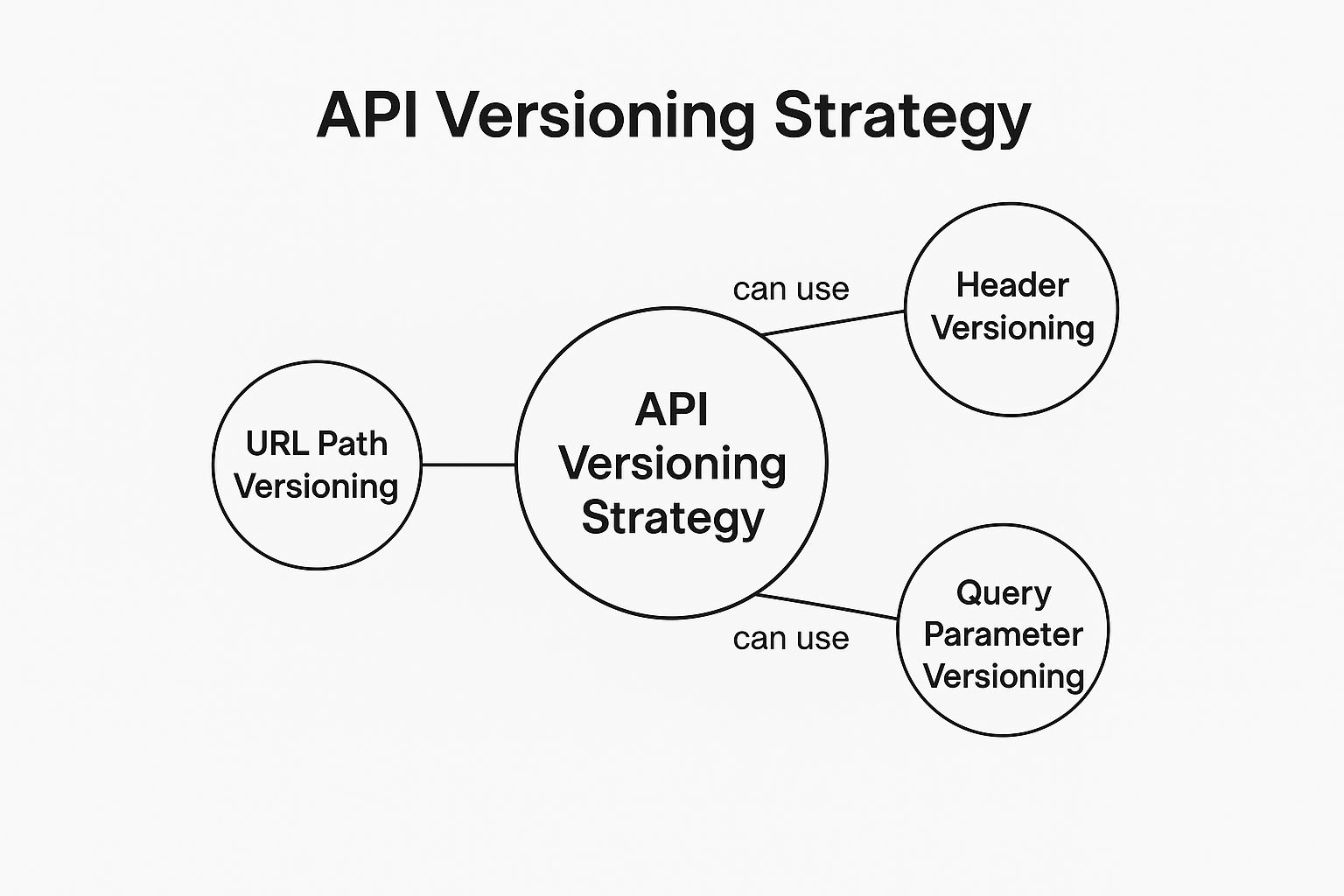
An effective API versioning strategy is crucial for evolving an API without disrupting existing client integrations. It allows you to introduce breaking changes, such as modifying data structures or removing endpoints, while providing a stable, predictable environment for consumers. A clear versioning plan ensures backward compatibility, giving developers time to adapt to new changes and preventing the widespread failures that unversioned updates can cause.
This concept map visualizes the primary methods for implementing an API versioning strategy, with each approach offering distinct advantages for different use cases.
Path, media-type, header, query, and date-based versioning each have tradeoffs. URL-path versions are visible, but visibility alone does not make them universally preferable. First decide what constitutes a breaking contract change, which clients need compatibility, and how versions, capabilities, and deprecations will be discovered.
Actionable Implementation Tips
To implement versioning successfully, choose a single, consistent method and clearly communicate your deprecation policies. Major API providers like GitHub and Salesforce manage multiple concurrent versions to support their vast developer ecosystems, demonstrating the importance of this practice for long-term stability and one of the most important api design best practices.
- Choose One Consistent Versioning Method: Decide whether to use URL pathing, headers, or query parameters and apply it uniformly across your entire API.
- Actionable Example: Use URL pathing like
GET /api/v2/users. This is the most explicit and common method, making it clear to developers which version they are targeting.
- Actionable Example: Use URL pathing like
- Define Compatibility Rules: Semantic Versioning was designed for software packages and does not by itself define HTTP representation compatibility. Document which changes are additive, behavioral, or breaking for your clients. A supposedly optional response field can still break consumers that reject unknown fields.
- Provide Evidence-Based Deprecation Timelines: Set notice periods from contracts, consumer inventory, risk, migration effort, and support capacity rather than a universal month count. RFC 9745 defines the
Deprecationresponse header and adeprecationlink relation; RFC 8594 definesSunsetfor the expected unavailability date. - Monitor Usage to Inform Decisions: Track which API versions are being used by clients. This data is invaluable for deciding when it's safe to fully deprecate an old version with minimal impact on your user base.
- Actionable Insight: Use your API gateway logs to determine that only 1% of traffic is still using
v1. This data supports the decision to proceed with its scheduled retirement.
- Actionable Insight: Use your API gateway logs to determine that only 1% of traffic is still using
6. Authentication and Authorization

Robust authentication and authorization are separate concerns. OAuth 2.0 is an authorization framework; OpenID Connect adds an identity layer for authentication; and JWT is a token format, not an authentication protocol. Choose established profiles and libraries according to client type and threat model, and enforce authorization at every resource boundary.
A well-designed security model balances strong protection with a positive developer experience. For instance, the GitHub API uses personal access tokens with fine-grained repository permissions, while Google's APIs leverage OAuth 2.0 with detailed scopes. These approaches ensure that applications only request the permissions they absolutely need, adhering to the principle of least privilege. This granular control is a core component of effective data access governance policies.
Actionable Implementation Tips
To effectively implement authentication and authorization, prioritize standard protocols over custom-built solutions. Relying on established frameworks like OAuth 2.0, popularized by major identity providers like Auth0 and Okta, saves development time and reduces the risk of security vulnerabilities.
- Use Current Security Profiles: For redirect-based OAuth clients, use Authorization Code with PKCE and exact redirect-URI matching as required or recommended by RFC 9700. Select machine-to-machine credentials from the threat model; an API key may identify a calling application but often lacks delegated-user semantics and fine-grained lifecycle controls.
- Design the Complete Token Lifecycle: Set lifetimes from risk, revocation capability, user experience, sender constraint, and client security rather than fixed universal values. Protect and rotate refresh tokens where applicable. For JWTs, validate permitted algorithms, issuer, audience, time claims, token type, signature, and keys according to RFC 8725.
- Require TLS: Do not accept credentials or bearer tokens over plaintext HTTP. Redirects are not a safe recovery mechanism after a secret has already been sent. HSTS helps supporting user agents—primarily browsers—avoid future HTTP connections, but API clients also need correct HTTPS endpoints, certificate validation, and secure TLS configuration.
- Define and Use Scopes: Clearly define granular permissions (scopes) that a client can request. This allows users to grant limited access to their data.
- Actionable Example: An e-commerce integration should request
read:productsandwrite:ordersscopes instead of a single, all-powerfulfull_accessscope.
- Actionable Example: An e-commerce integration should request
7. Rate Limiting and Throttling
Rate limiting controls request volume according to a defined policy and can protect capacity or allocate service fairly. It is only one resilience control and does not by itself prevent distributed denial-of-service attacks or guarantee availability. Pair it with authentication, quotas, timeouts, bounded work, caching, load shedding, abuse detection, and infrastructure-level protection as appropriate.
This practice is essential for maintaining performance and reliability at scale. It allows services to handle traffic spikes gracefully without crashing, making it a cornerstone of robust API infrastructure. For a deeper understanding of how this fits into a broader strategy, consider exploring effective endpoint management techniques.
Actionable Implementation Tips
Document what is limited, how callers are identified, the counting window or algorithm, burst behavior, concurrency rules, and what clients should do after rejection. Limits vary by endpoint, identity, plan, cost, and system state and should not be copied from another provider.
- Communicate the Policy: Document limits and expose machine-readable fields when your chosen API profile defines them. Historical
X-RateLimit-*names are provider conventions rather than core HTTP semantics, so clients must follow the contract you publish. - Use the
429 Too Many RequestsStatus Code: When a client exceeds the limit, respond with a429status code. When appropriate, includeRetry-After; RFC 6585 permits it but does not require it for every 429 response.- Actionable Example: If a user exceeds their limit, return a
429status and aRetry-After: 60header, instructing the client to wait 60 seconds before trying again.
- Actionable Example: If a user exceeds their limit, return a
- Partition Limits Deliberately: Limits may vary by credential, tenant, user, endpoint, operation cost, concurrency, or service tier. Test for noisy-neighbor behavior and avoid policies that let one distributed caller bypass protection simply by rotating identifiers.
- Choose the Right Algorithm: Consider different rate limiting algorithms based on your needs. A fixed window is simple to implement, but a sliding window algorithm provides a more fair and smooth limit enforcement.
- Actionable Insight: Use a sliding window algorithm to prevent clients from sending a burst of requests at the end of one window and the beginning of the next, which could still overwhelm your service.
8. Comprehensive Documentation and Developer Experience
An API's success is directly tied to how easily developers can understand and integrate it. Comprehensive documentation is the cornerstone of a positive developer experience (DX), transforming a powerful but obscure API into a tool that developers are eager to adopt. It goes far beyond a simple endpoint reference, encompassing interactive examples, clear getting-started guides, and robust support resources. The primary goal is to minimize the "time-to-first-success," the crucial period it takes for a developer to make their first successful API call.
Exceptional documentation acts as the primary user interface for your API. It should be intuitive, thorough, and supportive, guiding developers from initial exploration to full-scale production implementation. This focus on DX is a key differentiator in a crowded market; companies like Stripe and Twilio have built their reputations on providing world-class documentation that empowers developers to build quickly and confidently. This principle of clear, accessible information mirrors the importance of well-defined stages in other complex technical processes, such as the data science lifecycle.
Actionable Implementation Tips
To elevate your API from a functional tool to a developer-friendly platform, focus on creating documentation that is as well-designed as the API itself. For insights into how APIs are documented to ensure a seamless developer experience, you might find examples in practical API documentation.
- Use an API description and validate it: OpenAPI can describe HTTP APIs for documentation, tooling, testing, and client generation. It supports both design-first and code-first workflows; annotations alone do not guarantee that implementation and contract remain synchronized. Validate the document and run contract tests in CI.
- Provide Copy-and-Paste Code Examples: Include working code snippets in multiple popular programming languages (e.g., Python, JavaScript, Java). This drastically lowers the barrier to entry.
- Actionable Example: Stripe’s documentation allows users to switch between languages and see live, runnable code examples for each endpoint, complete with their own API keys populated.
- Create an Interactive API Explorer: Offer a "Try it out" feature directly within your documentation, allowing developers to make real API calls and see responses without leaving the page.
- Actionable Insight: Tools like Swagger UI or Redoc can be configured to include an interactive console, which is invaluable for quick experimentation and debugging.
- Offer Language-Specific SDKs: Develop and maintain Software Development Kits (SDKs) for popular languages. SDKs handle boilerplate code like authentication and request formatting, accelerating integration.
- Actionable Insight: Instead of forcing developers to manually construct HTTP requests and handle token refreshes, provide an official Python SDK that simplifies making an API call to a single line of code.
- Maintain a Detailed Changelog: Clearly document all versions and changes to the API, including deprecations and new features. This transparency builds trust and helps developers manage updates.
- Actionable Example: Maintain a
/changelogpage that lists updates by date, specifying whether a change is anAdded Feature,Improvement, orBreaking Change.
- Actionable Example: Maintain a
API Design Review Checklist
| Area | Review question | Evidence |
|---|---|---|
| HTTP semantics | Do methods, status codes, caching, conditional requests, and representations match their standardized meaning? | Contract tests and RFC 9110 review |
| Errors | Can clients handle failures without parsing prose or receiving sensitive internals? | RFC 9457 problem types and negative tests |
| Evolution | Are compatibility, deprecation, migration, and sunset rules explicit? | Consumer inventory, changelog, Deprecation and Sunset signals |
| Security | Are authentication, authorization, token validation, TLS, and least privilege tied to a threat model? | Security tests and RFC 9700/RFC 8725 controls |
| Resilience | Are timeouts, retries, idempotency, quotas, pagination, and overload behavior documented? | Load, failure, and retry-safety tests |
| Developer experience | Can a consumer discover, test, monitor, and migrate the API? | Validated OpenAPI document, examples, sandbox, SDK tests, and support path |
From Principles to Practice: Your Next Steps in API Design
Navigating the landscape of API design can seem daunting, but as we've explored, a set of core principles can guide you toward building robust, scalable, and developer-friendly interfaces. Mastering API design is not a one-time task; it's an iterative process of refinement and a commitment to quality that pays substantial dividends over the long term. The best practices detailed in this article are not merely technical checkboxes but foundational pillars that support a successful digital ecosystem.
The journey from a functional API to an exceptional one is paved with intentional design choices. By embracing RESTful principles, you create a logical and intuitive structure. By implementing a consistent URL scheme and using HTTP status codes correctly, you build a predictable and reliable experience for developers. These are the cornerstones of effective API design best practices.
Synthesizing the Core Takeaways
The most impactful APIs are those that prioritize the developer experience. This means going beyond the basic functionality to consider every interaction a developer will have with your system.
Key takeaways to internalize and apply include:
- Clarity and Consistency are Paramount: From your endpoint naming conventions (
/users/{userId}/orders) to your error messages ({"error": "Invalid API key provided"}), predictability reduces cognitive load and accelerates development for your API consumers. - Security is Not an Afterthought: Implementing robust authentication and authorization, alongside sensible rate limiting, is non-negotiable. These measures protect your infrastructure, your data, and your users from misuse and attacks.
- Plan for Evolution: A well-defined versioning strategy (like
/v2/products) ensures you can introduce breaking changes and new features without disrupting existing integrations, preserving trust within your developer community. - Documentation is the User Interface: Your API is only as good as its documentation. Comprehensive, interactive, and easy-to-navigate documentation (like that produced by Swagger/OpenAPI) is the single most critical element for driving adoption and ensuring long-term success.
Your Actionable Path Forward
Theory is valuable, but application is where true mastery is forged. To translate these API design best practices from concept to reality, consider these immediate next steps:
- Conduct an API Audit: Select one of your existing APIs, even a small internal one. Review it against the principles we've discussed. Does it use appropriate HTTP verbs? Is error handling consistent? Is the documentation up-to-date? This practical exercise will immediately highlight areas for improvement.
- Create a Design Checklist: Before writing a single line of code for your next project, create a design document or checklist based on these best practices. Ensure every new endpoint or feature is vetted against these standards for versioning, security, and error handling.
- Champion Developer Experience: Advocate within your team or organization for a "developer-first" mindset. This involves gathering feedback from API consumers, investing in better tooling, and treating your API documentation as a first-class product.
Ultimately, a thoughtfully designed API is a powerful business asset. It accelerates internal development, enables powerful partner integrations, and can even become a core product offering. By committing to these principles, you are not just building software; you are creating a stable, secure, and empowering platform that enables others to build the future.
Primary references
- RFC 9110: HTTP Semantics
- RFC 9457: Problem Details for HTTP APIs
- RFC 9700: Best Current Practice for OAuth 2.0 Security
- RFC 8725: JSON Web Token Best Current Practices
- RFC 9745: The Deprecation HTTP Response Header Field
- RFC 6585: 429 Too Many Requests
- OpenAPI Specification
Fact-check record
Reviewed September 4, 2026. HTTP terminology was aligned with RFC 9110 and RFC 9457. Versioning and deprecation guidance now uses RFC 9745 and Sunset semantics rather than arbitrary schedules and the Warning header. OAuth, OpenID Connect, JWT, PKCE, TLS, and token-lifecycle claims were corrected using RFC 9700 and RFC 8725. Nonstandard rate-limit headers and copied provider quotas were removed, and the subjective comparison matrix was replaced with a verifiable review checklist.

Historical comments from Datanizant
No public comments on this article
1 imported entry withheld from public display after manual spam and duplicate review. The source archive remains unchanged.