In today's digital-first landscape, simply being "on the cloud" is no longer a differentiator; it's the baseline. The real competitive advantage lies in how you use it. Effective cloud computing strategies are the bedrock of scalable, secure, and cost-efficient operations, turning infrastructure from a mere utility into a powerful engine for innovation. Without a deliberate strategy, businesses risk uncontrolled spending, security vulnerabilities, and operational inefficiencies that can stifle growth and innovation.
As organizations push the boundaries of AI and data science, their success is often underpinned by a sophisticated approach to cloud architecture. This article moves beyond the basics to provide a comprehensive roundup of nine critical strategies, complete with actionable insights and practical implementation details. We will explore how to harness the cloud's full potential, ensuring your digital infrastructure is not just operational, but transformational.
This guide is designed for a diverse audience, from enterprise IT leaders and machine learning engineers to technology strategists and data scientists. You will learn to navigate complex decisions surrounding:
- Architectural Choices: Deciding between multi-cloud, hybrid, or cloud-native approaches.
- Operational Excellence: Implementing robust cost optimization, security, and governance frameworks.
- Modernization Pathways: Evaluating lift-and-shift migrations versus serverless computing.
Whether you are refining an existing setup or planning a new migration, the cloud computing strategies detailed here will equip you to make informed decisions that align technology with your long-term business goals. Let's explore the frameworks that will define your organization's digital future.
1. Multi-Cloud Strategy
A multi-cloud strategy uses services from more than one cloud provider for explicit business or technical requirements. It can broaden service choice or reduce concentration risk, but it also adds identity, networking, observability, governance, data-transfer, and skills complexity. Use it only when the expected value exceeds those costs.
This method has become one of the most vital cloud computing strategies for enterprises seeking to avoid vendor lock-in and enhance resilience. For instance, a retail company might use Google Cloud's BigQuery for its powerful data analytics and machine learning on customer data while running its e-commerce platform on AWS for its mature and extensive services like RDS and EC2. This strategic allocation allows teams to use the ideal environment for each specific task.
Why Adopt a Multi-Cloud Approach?
The primary driver for a multi-cloud strategy is flexibility. It empowers organizations to negotiate better pricing and avoid the business risk associated with dependency on a single provider's technology stack, pricing model, and roadmap.
Merely deploying workloads to two providers does not create cross-cloud disaster recovery. Recovery requires compatible standby capacity, replicated and recoverable data, independent dependencies, traffic-management controls, tested runbooks, and recovery objectives. For many workloads, a well-architected multi-zone or multi-region design within one provider may satisfy the requirement with less complexity.
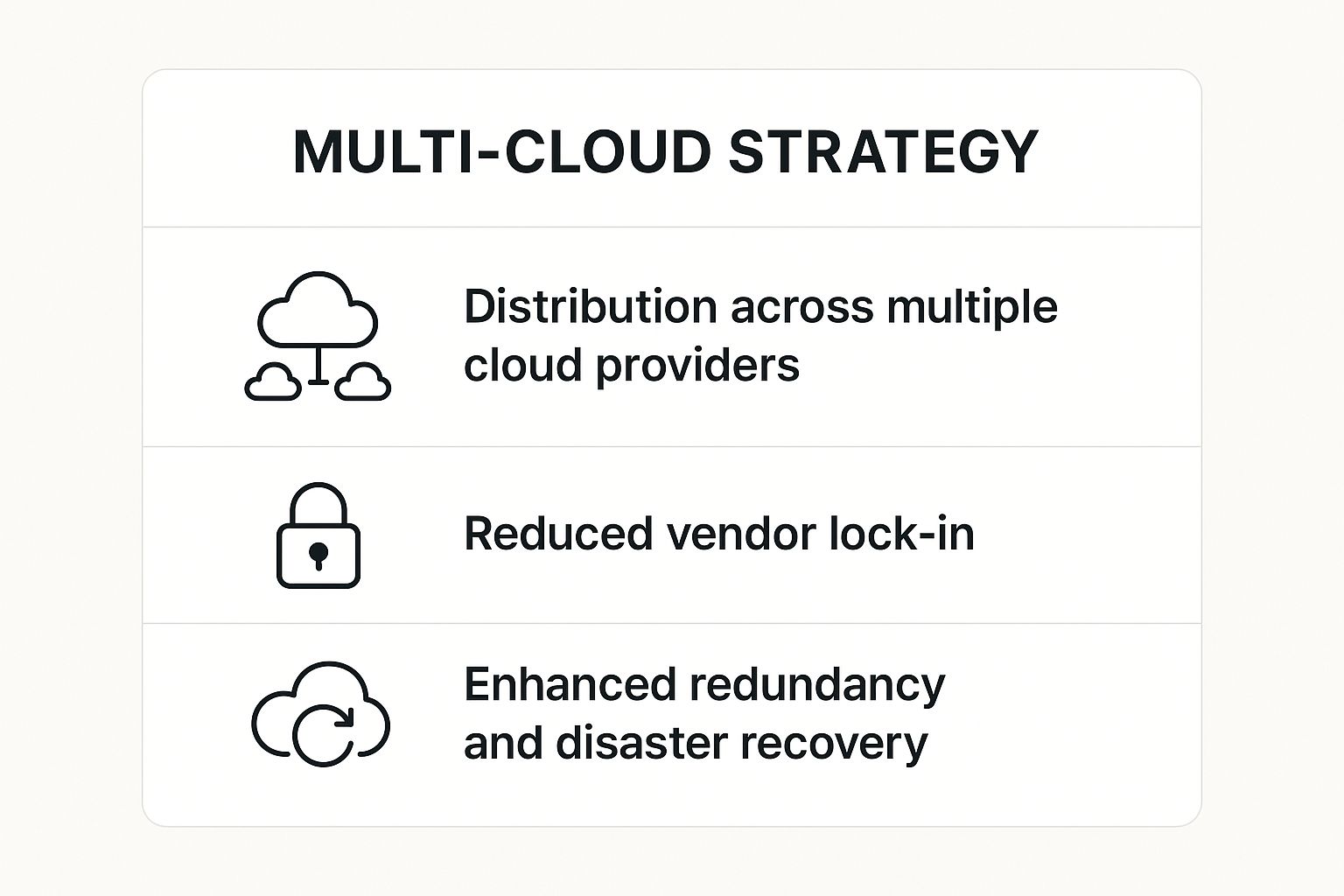
The infographic below highlights the core tenets of a multi-cloud strategy for quick reference.
These three pillars-distribution, independence, and resilience-form the foundation of a robust multi-cloud architecture that provides strategic agility.
Actionable Implementation Tips
Successfully managing a multi-cloud environment requires careful planning and the right tools.
- Keep provider differences explicit: Infrastructure as code can standardize review, versioning, and deployment workflows, but it does not erase provider differences or create a universal management plane. Share organizational interfaces and policy tests where useful while retaining provider-specific modules.
- Standardize on Containerization: Embrace technologies like Docker and Kubernetes. Containers abstract applications from the underlying infrastructure, making them highly portable. Actionable Insight: Package your application into a Docker container and orchestrate it with Kubernetes. This ensures your application runs identically on any cloud provider, drastically simplifying deployment and management.
- Establish a Centralized Governance Framework: Create clear policies for security, compliance, and cost management that apply across all providers. Actionable Insight: Use a policy-as-code tool like Open Policy Agent (OPA) to enforce rules, such as requiring specific resource tags or prohibiting public S3 buckets, regardless of whether the resource is on AWS, Azure, or GCP.
2. Cloud-First Strategy
A cloud-first strategy establishes cloud solutions as the default choice for all new IT projects and application deployments. Instead of starting with on-premises infrastructure and justifying a move to the cloud, this approach reverses the model. Organizations begin with the assumption that a cloud service is the best fit unless specific, compelling reasons such as regulatory constraints or unique performance needs mandate an on-premises solution.
This strategic shift is fundamental to modernizing IT infrastructure and accelerating innovation. It's one of the most transformative cloud computing strategies because it moves organizations from opportunistic cloud adoption to a systematic, forward-thinking posture. Practical Example: When a development team needs a new database, a cloud-first policy dictates they first evaluate managed services like Amazon RDS or Azure SQL Database before considering deploying a self-managed database on a virtual machine or on-premises server.
Why Adopt a Cloud-First Approach?
Cloud services can shorten infrastructure lead time when landing zones, identity, networking, guardrails, quotas, and delivery pipelines are already in place. Consumption pricing can shift some spending from capital to operating expense, but variable usage does not make cost inherently predictable. Forecasts, budgets, allocation metadata, anomaly detection, and commitment management remain necessary.
A key benefit is fostering an innovation-centric culture. Teams gain direct access to cutting-edge technologies like serverless computing, big data analytics, and artificial intelligence without requiring massive upfront investment. As discussed in our deep dive on cloud migration challenges on Data4AI.org, adopting a cloud-first mindset early can prevent many of the legacy hurdles that complicate future migrations.
Actionable Implementation Tips
Transitioning to a cloud-first mindset requires a deliberate cultural and operational shift, supported by strong governance.
- Establish a Cloud Center of Excellence (CCoE): Create a dedicated team to develop best practices, create reusable infrastructure-as-code templates, and provide expert guidance. Actionable Insight: Your CCoE can build and maintain a library of pre-approved Terraform modules or CloudFormation templates for common architectures (e.g., a secure three-tier web application), accelerating secure deployment for all teams.
- Invest in Continuous Team Training: Equip your development and operations teams with the necessary skills for cloud-native architecture. Actionable Insight: Sponsor role-specific certification paths (e.g., AWS Certified Developer, Azure Security Engineer) and provide access to hands-on lab environments like A Cloud Guru or Qwiklabs to build practical expertise.
- Implement Proactive Governance and Cost Management: Deploy tools to monitor cloud spending, set budgets, and enforce security policies from day one. Actionable Insight: Configure budget alerts in AWS Budgets or Azure Cost Management to automatically notify project owners and finance teams when spending is forecasted to exceed its allocation, preventing surprises at the end of the month.
3. Hybrid Cloud Strategy
Hybrid architecture connects on-premises and public-cloud environments, but management and data movement are not automatically unified. Define which systems are authoritative, where regulated data may reside, how identities and keys are federated, how connectivity fails over, and how controls are measured in each environment.
This approach has become one of the most practical cloud computing strategies for established enterprises with significant existing infrastructure investments. It provides a bridge to modernization without a disruptive "lift-and-shift" of all assets. Practical Example: A financial institution uses a hybrid cloud to process transactions on its secure, low-latency on-premises servers while using the public cloud to run its customer-facing mobile banking app and perform large-scale data analytics on anonymized data.
Why Adopt a Hybrid Cloud Approach?
The primary motivation for a hybrid strategy is achieving a balance between control and scalability. It enables businesses to meet strict regulatory or data sovereignty requirements by keeping certain data within a private environment, while still benefiting from the public cloud’s vast resource pool for less sensitive operations, development, and testing.
A key benefit is enhanced operational agility. Organizations can "cloud-burst," moving workloads to the public cloud to handle temporary spikes in demand, then scaling back down to their private infrastructure once the peak passes. This prevents over-provisioning on-premises hardware. As we cover in Data4AI's guides on data access governance, a hybrid model requires meticulous planning to ensure consistent data protection policies across both environments.
Actionable Implementation Tips
Building an effective hybrid cloud requires seamless integration and consistent management across disparate environments.
- Establish Robust Network Connectivity: Use dedicated, high-bandwidth connections like AWS Direct Connect or Azure ExpressRoute to ensure low-latency, secure, and reliable communication between your on-premises data center and the public cloud. Actionable Insight: Work with your network team to establish a primary and a backup dedicated connection to prevent a single point of failure and ensure business continuity.
- Use Unified Management Tools: Employ hybrid cloud management platforms like Microsoft Azure Arc, Google Anthos, or AWS Outposts to manage both on-premises and cloud resources from a single control plane. Actionable Insight: Use Azure Arc to apply Azure security policies and monitoring to your on-premises servers, giving you a consistent governance and observability posture across your entire estate.
- Federate identity deliberately: Use Microsoft Entra ID (formerly Azure Active Directory), or the organization’s chosen identity provider, where appropriate. Federation or SSO does not by itself create identical authorization policies; map least-privilege roles and lifecycle controls for every target system.
4. Cloud-Native Development Strategy
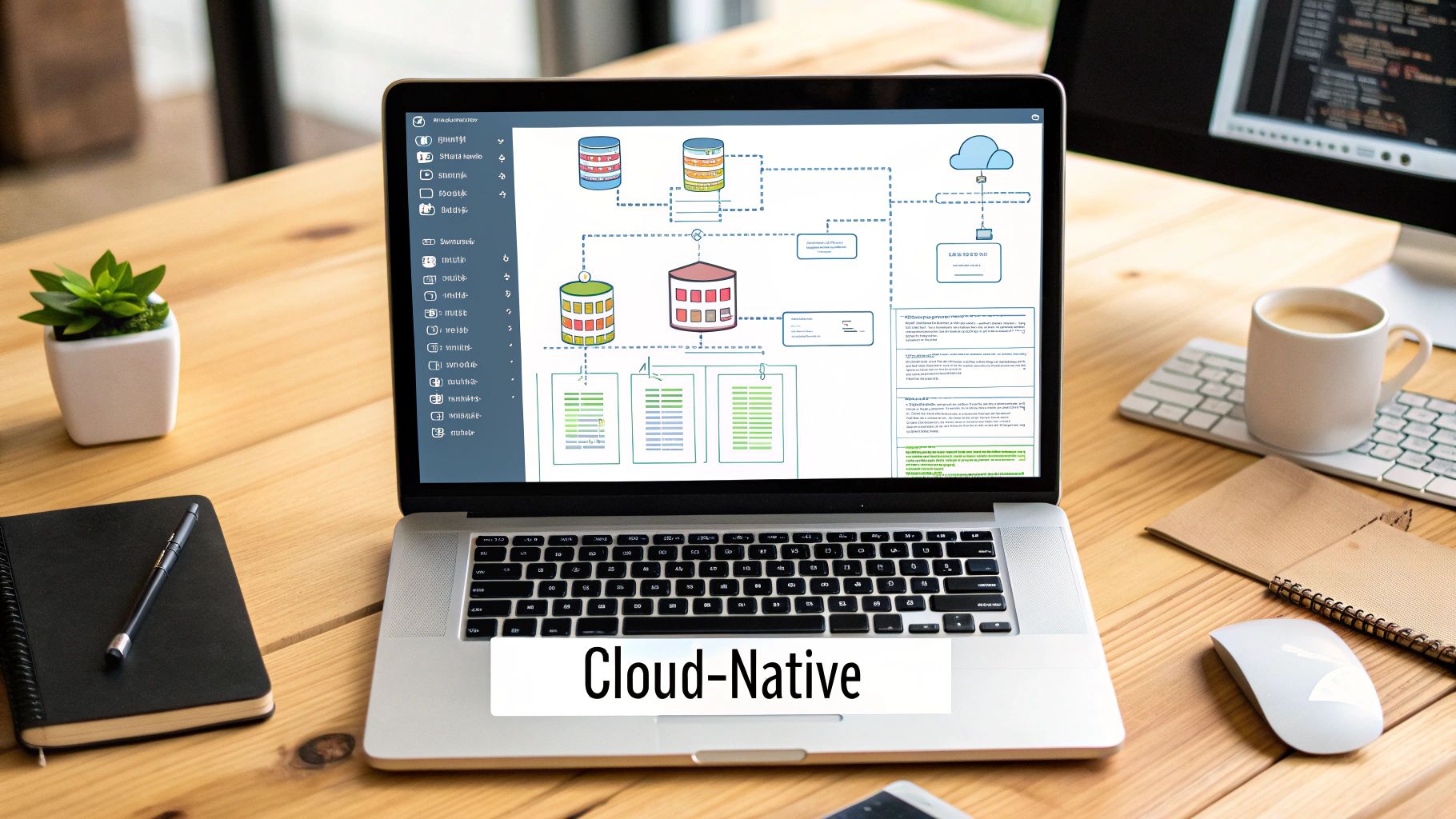
A cloud-native development strategy involves building and running applications designed specifically to leverage the full potential of cloud computing environments. Rather than simply migrating existing applications, this approach uses modern techniques like microservices, containers, and serverless computing to create systems that are scalable, resilient, and flexible. It is a fundamental shift in how applications are designed, built, and deployed, championed by organizations like the Cloud Native Computing Foundation (CNCF).
This method has become one of the most transformative cloud computing strategies because it directly aligns application architecture with the dynamic nature of the cloud. Practical Example: A food delivery app is built as a set of microservices—one for user accounts, one for restaurant menus, one for order processing, and one for driver tracking. Each service can be scaled, updated, and deployed independently, allowing the company to rapidly add new features to one part of the app without risking the stability of the others.
Why Adopt a Cloud-Native Approach?
The core motivation for adopting a cloud-native strategy is business agility and scalability. By breaking down large, monolithic applications into smaller, independent microservices, teams can develop, deploy, and scale individual components without impacting the entire system. This accelerates release cycles and fosters innovation.
Service boundaries and orchestration can support fault isolation, health-based replacement, and independent scaling, but resilience remains an application property. Shared databases, synchronous dependency chains, retry storms, misconfigured probes, unavailable dependencies, or correlated deployments can still cause system-wide failure. Define service-level objectives, timeouts, idempotency, back-pressure, failure domains, and recovery tests.
Actionable Implementation Tips
Transitioning to cloud-native development requires a strategic approach and a commitment to new tools and methodologies.
- Start with Pilot Projects: Rather than a "big bang" migration, begin with a small, non-critical application or a new feature. Actionable Insight: Choose a new, low-risk internal tool to build using microservices and containers. This allows your team to learn technologies like Docker and Kubernetes and refine your CI/CD processes in a safe environment.
- Invest in a Container Orchestration Platform: Adopt a robust, managed container orchestration platform like Amazon EKS, Google GKE, or Azure AKS. Actionable Insight: Offloading the management of the Kubernetes control plane to a cloud provider allows your team to focus on application development and deployment rather than complex cluster administration.
- Implement Infrastructure as Code (IaC): Use tools like Terraform or AWS CloudFormation to define and manage your infrastructure through code. Actionable Insight: Store your IaC definitions in a Git repository. This enables peer review, version history, and automated deployment pipelines, ensuring your infrastructure is repeatable, consistent, and auditable.
5. Cloud Cost Optimization Strategy
A cloud cost optimization strategy is a continuous, disciplined approach to managing and reducing cloud spending without negatively impacting performance, reliability, or security. This goes beyond simply turning off unused resources; it involves a comprehensive framework of financial governance, resource management, and operational best practices, often called FinOps. The goal is to maximize the business value derived from cloud investments, ensuring every dollar spent is efficient and aligned with strategic objectives.
This method has become one of the most critical cloud computing strategies as organizations scale their cloud adoption and face ballooning operational expenses. Practical Example: A gaming company uses Spot Instances on AWS for its nightly data processing jobs. These instances, which can be up to 90% cheaper, are perfect for fault-tolerant workloads. For its core game servers, it purchases Savings Plans to get a significant discount on the stable, predictable portion of its compute usage, blending pricing models to maximize savings.
Why Adopt a Cloud Cost Optimization Approach?
The primary driver for cost optimization is maximizing return on investment (ROI). In the pay-as-you-go cloud model, unmonitored usage can quickly lead to budget overruns, eroding the financial benefits of moving to the cloud in the first place.
A key benefit is enhanced operational efficiency and resource visibility. By implementing cost allocation and monitoring, organizations gain a granular understanding of which teams, projects, or applications are driving expenses. This visibility allows for informed decision-making and accountability. As discussed in our detailed guide to cloud computing for machine learning at Data4AI, aligning cost controls with project goals is essential, especially for resource-intensive workloads like model training.
Actionable Implementation Tips
Effectively optimizing cloud costs requires a combination of smart tooling, disciplined processes, and a culture of cost-consciousness.
- Enforce allocation safely: Require allocation metadata at provisioning where possible, quarantine or deny clearly noncompliant resources, and provide an exception workflow. Do not terminate production workloads solely because a tag is missing.
- Rightsize from workload evidence: Combine CPU, memory, accelerator, network, storage, latency, schedule, ownership, and business criticality. Automate shutdown only for pre-approved nonproduction classes with recovery safeguards.
- Commit only after measurement: Purchase Savings Plans or reservations after establishing a stable usage baseline and evaluating coverage, utilization, commitment, and change risk. Advertised discounts are maxima, not guaranteed savings.
6. Cloud Security Strategy

Cloud security is a shared responsibility whose boundary varies by service and deployment model. The provider protects cloud infrastructure; the customer remains accountable for identities, data, configuration, and application controls, with additional duties for self-managed compute. Document the responsibility matrix for each service.
This approach has become one of the most critical cloud computing strategies as organizations move sensitive workloads to the cloud. It addresses unique challenges like ephemeral resources, distributed architectures, and complex identity management. Practical Example: A healthcare provider uses a zero-trust architecture. Every request to access patient data, even from within the "trusted" corporate network, must be independently authenticated and authorized against strict IAM policies, and all data is encrypted both in transit and at rest.
Why Adopt a Cloud Security Strategy?
The primary driver for a formal cloud security strategy is to mitigate risk in a complex and dynamic environment. Without a deliberate plan, organizations are vulnerable to data breaches, compliance violations, and misconfigurations, which are the leading cause of cloud security incidents. A robust strategy ensures that security is integrated into every stage of the cloud lifecycle, from development to deployment and operations.
A key benefit is proactive threat detection and response. By using specialized tools and automated monitoring, organizations can identify and remediate vulnerabilities before they can be exploited. This proactive stance is far more effective than reacting to incidents after they occur. As discussed in our articles at Data4AI, effective network security is foundational to a strong cloud security posture.
Actionable Implementation Tips
Implementing a strong cloud security strategy requires a multi-layered approach that combines technology, processes, and people.
- Implement a Zero-Trust Model: Assume no implicit trust. Authenticate and authorize every request based on all available data points. Actionable Insight: Use a service mesh like Istio or Linkerd in your Kubernetes cluster to enforce mutual TLS (mTLS) for all service-to-service communication, ensuring that even internal traffic is encrypted and authenticated.
- Use posture management with controlled remediation: Capabilities such as AWS Security Hub CSPM or Microsoft Defender for Cloud, together with provider-native policy services, can identify misconfiguration. Automate remediation only when tested, reversible, and scoped to a known resource class.
- Automate Security Policy Enforcement in CI/CD: Integrate security checks directly into your deployment pipelines (DevSecOps). Actionable Insight: Add a step in your CI/CD pipeline that uses a tool like Snyk or Trivy to scan container images for known vulnerabilities. The pipeline should fail automatically if any high-severity vulnerabilities are found, preventing insecure code from ever reaching production.
7. Lift and Shift Migration Strategy
A lift and shift migration strategy, also known as rehosting, involves moving an existing application and its associated data to a cloud infrastructure with minimal or no code changes. This approach essentially duplicates your on-premises environment in the cloud, prioritizing speed and simplicity over immediate optimization. It is one of the foundational cloud computing strategies for organizations beginning their cloud journey or needing to exit a data center quickly.
This method is particularly effective for legacy systems or large-scale enterprise applications where refactoring would be too costly or time-consuming in the short term. Practical Example: A manufacturing company needs to exit its aging data center within six months. It uses the AWS Application Migration Service (MGN) to replicate its on-premises servers, including a critical ERP system, directly into AWS EC2 instances. The application continues to function as before, but the company successfully meets its deadline and eliminates its data center hardware costs.
Why Adopt a Lift and Shift Approach?
The primary driver for a lift and shift strategy is rapid migration. It offers the fastest path to the cloud, allowing businesses to meet urgent deadlines for data center closures or to quickly start leveraging cloud infrastructure benefits without a lengthy and complex re-architecting process.
Rehosting can reduce application-code changes and accelerate a data-center exit, but it shifts rather than removes risk. Network behavior, identity, licensing, storage semantics, latency, backup, observability, and operating procedures can still change. Test dependency maps, performance, recoverability, cutover, and rollback, then plan post-migration rightsizing and modernization.
Actionable Implementation Tips
A successful lift and shift migration requires careful planning to avoid simply moving problems from on-premises to the cloud.
- Assess Application Dependencies Thoroughly: Before migrating, use discovery tools to map out all network, data, and service dependencies. Actionable Insight: Use a tool like AWS Application Discovery Service or Azure Migrate to automatically scan your on-premises environment and generate a detailed dependency graph. This visual map helps you identify which servers must be migrated together to avoid breaking the application.
- Plan for Post-Migration Optimization: Treat lift and shift as phase one. Create a roadmap for modernizing the application post-migration. Actionable Insight: Immediately after migrating your application, start by replacing self-managed databases with a managed service like Amazon RDS. This single change can significantly reduce operational overhead and improve reliability, serving as an easy first optimization win.
- Use Cloud Provider Migration Tools: Leverage services like AWS Application Migration Service or Azure Migrate. Actionable Insight: Conduct a non-disruptive test cutover using your chosen migration tool. This allows you to validate the entire migration process and measure the final cutover time without impacting your production on-premises environment.
8. Serverless Computing Strategy
A serverless computing strategy involves building and running applications and services without managing the underlying server infrastructure. This approach allows developers to focus purely on writing code, as the cloud service provider (CSP) handles provisioning, scaling, and maintaining the servers. Applications are broken down into event-driven, stateless functions that execute in response to specific triggers, such as an HTTP request or a file upload.
Serverless services remove server provisioning and operating-system management from the application team, but not operational responsibility. Teams still own code, dependencies, identities, data protection, concurrency and quota design, observability, retries, idempotency, and cost behavior.
Why Adopt a Serverless Approach?
The core appeal of a serverless strategy is its inherent efficiency and cost-effectiveness. You pay only for the compute time you consume, down to the millisecond, which eliminates costs associated with idle server capacity. This granular, pay-as-you-go model is ideal for applications with unpredictable or spiky traffic patterns.
Furthermore, serverless architectures promote incredible agility. Since developers do not need to worry about server management, they can build and deploy new features faster. This accelerates the development lifecycle and allows teams to innovate more rapidly. As explored in our guides at Data4AI, serverless is a powerful paradigm for building event-driven data processing pipelines.
Actionable Implementation Tips
Adopting a serverless model requires a shift in architectural thinking and development practices.
- Design for Statelessness: Ensure your functions are stateless. Each invocation should be independent, with no memory of previous executions. Actionable Insight: Instead of storing session information in the function's memory, persist it in an external, highly-available datastore like Amazon DynamoDB or Redis. This allows any function instance to serve any request.
- Plan for execution-environment initialization: A cold start occurs when the platform creates and initializes a new execution environment—not only on the first invocation. AWS Lambda Provisioned Concurrency prepares a configured number of environments and reduces startup latency within that allocation; spillover can still use on-demand environments and experience cold starts.
- Leverage Serverless Frameworks: Use tools like the Serverless Framework or AWS SAM (Serverless Application Model) to streamline development. Actionable Insight: Define your entire serverless application—including functions, API endpoints, and database tables—in a single
serverless.ymlor SAM template file. This allows you to deploy and update your entire application stack with a single command.
9. Cloud Governance Strategy
A cloud governance strategy is a comprehensive framework of policies, procedures, and controls designed to manage and secure an organization's cloud resources. It provides a structured approach to cloud adoption, ensuring that usage is effective, compliant, and cost-efficient. Rather than letting teams operate in an uncontrolled environment, a governance model establishes the "rules of the road" for provisioning, managing, and decommissioning cloud services.
This framework is one of the most critical cloud computing strategies for scaling operations without introducing unmanageable risk or runaway costs. It balances the need for developer agility with the enterprise's requirements for security, compliance, and financial oversight. Practical Example: A large enterprise uses AWS Control Tower to set up a multi-account structure. It applies Service Control Policies (SCPs) at the organizational level to prevent any user—even an administrator—from disabling critical security services like CloudTrail or creating resources in unapproved geographic regions.
Why Adopt a Cloud Governance Approach?
The core driver for implementing a cloud governance strategy is to mitigate risk and optimize value. Without it, organizations face potential security vulnerabilities, compliance breaches, and spiraling expenses. A well-defined governance framework ensures that every cloud resource is accounted for, secured, and aligned with business objectives.
A key benefit is enhanced security and compliance. By defining and automating policies, companies can enforce security baselines, data residency rules, and access controls consistently across all cloud environments. As highlighted in our guides, effective data access governance is a cornerstone of this clarity, ensuring that policies are not just written down but actively enforced.
Actionable Implementation Tips
Implementing effective cloud governance is an iterative process that evolves with your organization's cloud maturity.
- Establish a Governance Framework: Start with a lightweight model using cloud-native tools. Actionable Insight: Use AWS Control Tower or Azure Landing Zones to provision a secure, multi-account baseline environment. This automatically sets up foundational guardrails for identity, logging, and network security, giving you a safe foundation to build upon.
- Automate Policy Enforcement: Use Infrastructure as Code (IaC) and policy-as-code tools to automatically enforce your governance policies. Actionable Insight: Implement an Azure Policy that automatically adds a "delete_after_30_days" tag to any resource created in a designated sandbox environment. A separate automated script can then run daily to find and delete any expired resources, preventing sandbox cost sprawl.
- Define Clear Roles and Responsibilities (RACI Matrix): Create a Cloud Center of Excellence (CCoE). Actionable Insight: Develop a RACI (Responsible, Accountable, Consulted, Informed) chart for key cloud operations. For example, for "Cloud Cost Management," the Project Manager might be Responsible, the Department Head Accountable, the FinOps team Consulted, and the CCoE Informed. This eliminates confusion and ensures clear ownership.
Cloud Computing Strategies Comparison
| Strategy | Use when | Primary trade-off | Evidence to collect | Exit/recovery test |
|---|---|---|---|---|
| Multi-cloud | A specific requirement exceeds one provider’s acceptable capability or concentration risk | Cross-provider operational complexity | Data residency, dependency, skills, transfer cost | Prove data recovery and traffic failover |
| Cloud-first | Governed landing zones and delivery paths make managed services the default fit | Variable cost and provider coupling | Lead time, unit cost, quotas, portability needs | Test export, backup, and account recovery |
| Hybrid | Latency, regulation, assets, or migration sequencing requires two environments | Identity, network, and control duplication | Latency, residency, authoritative systems | Test connectivity loss and local continuity |
| Cloud-native | Independent delivery or scaling justifies distributed operations | Platform and application complexity | SLOs, dependency graph, team maturity | Run failure-domain and restore tests |
| Cost optimization | Usage and ownership data support accountable decisions | Commitment and automation risk | Utilization, coverage, unit economics | Test reversibility of automated actions |
| Cloud security | Every cloud workload | Control coverage varies by service model | Responsibility matrix, identity and data paths | Exercise incident response and key recovery |
| Rehosting | Exit speed outweighs immediate modernization value | Legacy architecture and cost persist | Dependencies, performance, licensing | Prove cutover and rollback |
| Serverless | Event-driven or variable workloads fit service limits | Quotas, startup latency, observability, coupling | Concurrency, duration, latency, unit cost | Test retries, spillover, and regional recovery |
| Governance | Always; scope controls to risk | Friction from poorly designed guardrails | Policy coverage, exceptions, ownership | Test break-glass and policy rollback |
From Strategy to Success: Unifying Your Cloud Approach
Navigating the vast landscape of cloud computing can feel overwhelming, but as we have explored, a well-defined plan transforms this complexity into a powerful competitive advantage. The journey from initial concept to a fully optimized cloud environment is not about selecting a single, isolated path. Instead, success lies in the thoughtful integration of multiple, interlocking cloud computing strategies. The true art is not in choosing between a multi-cloud architecture and a serverless approach, but in understanding how they can work in concert to achieve specific business outcomes.
A robust cloud security posture, for instance, isn't a standalone project; it's a foundational layer that must be woven into every decision. When your team embraces a cloud-native development strategy, security principles like DevSecOps must be integrated from the very first line of code, not bolted on as an afterthought. Similarly, the principles of a strong cloud governance strategy provide the essential guardrails that make a sophisticated multi-cloud or hybrid cloud environment manageable, preventing sprawl and ensuring compliance across disparate platforms.
Synthesizing Your Strategic Blueprint
The key takeaway is that these strategies are not a menu to choose from, but rather a set of interconnected tools in your digital transformation toolkit. Consider how they build upon one another:
- Foundation: A Cloud-First Strategy sets the organizational mindset, prioritizing cloud solutions for all new initiatives. This establishes the momentum needed for broader transformation.
- Architecture: Your choice of a Multi-Cloud or Hybrid Cloud Strategy defines the operational landscape. This decision is driven by needs for resilience, data sovereignty, or leveraging best-of-breed services from different providers.
- Execution: Cloud-Native Development and Serverless Computing are the engines of innovation within that architecture. They enable your teams to build, deploy, and scale applications with unprecedented speed and efficiency.
- Optimization: A dedicated Cloud Cost Optimization Strategy ensures that this innovation is financially sustainable. This is not just about cutting costs; it's about maximizing the business value derived from every dollar spent on cloud resources, a core tenet of FinOps. As highlighted in Data4AI's analyses of cloud economics, treating cost as a first-class metric is crucial.
- Control: Finally, Cloud Governance and Cloud Security strategies act as the central nervous system, ensuring the entire ecosystem is secure, compliant, and aligned with business objectives. They provide the framework that allows for rapid innovation without introducing unacceptable risk.
Your Actionable Path Forward
Moving from theory to practice requires a deliberate, phased approach. Don't attempt to implement all these cloud computing strategies at once. Instead, begin by assessing your organization's current maturity and immediate business drivers.
- Start with an Audit: Where are you now? Evaluate your existing applications, infrastructure, and team skill sets. Identify the most pressing pain points. Is it spiraling costs? Slow development cycles? Security vulnerabilities?
- Define a Core Strategy: Based on your audit, select a primary strategic driver. If your goal is rapid modernization of a legacy application, a Lift and Shift Migration Strategy might be the logical first step, followed by a phased refactoring toward a Cloud-Native model.
- Establish Governance Early: Before you scale, implement a foundational Cloud Governance Strategy. Define your tagging policies, budget alerts, and access controls. This proactive step will prevent costly and complex cleanup efforts down the road.
- Iterate and Expand: Treat your cloud strategy as a living document. As your business evolves and your team's expertise grows, continuously revisit and refine your approach. What started as a simple hybrid model may evolve into a sophisticated, secure multi-cloud ecosystem powered by serverless functions and governed by FinOps principles.
Ultimately, mastering these interconnected cloud computing strategies is about more than just technology; it is about building an organization that is agile, resilient, and ready for the future. By moving beyond isolated tactics and embracing a unified, strategic vision, you can unlock the full transformative potential of the cloud, turning your infrastructure into a true engine for innovation and growth.
Primary references
- AWS: multicloud strategy recommendations
- AWS: workload dependencies and failover
- AWS shared-responsibility model
- AWS Lambda Provisioned Concurrency
- AWS Cost Optimization Pillar
- Microsoft: Azure AD renamed Microsoft Entra ID
- Microsoft: Azure governance design area
Fact-check record
Reviewed September 4, 2026. Corrected multi-cloud failover, IaC portability, cloud-cost predictability, hybrid identity, microservice and Kubernetes resilience, unsafe resource deletion, shared responsibility, current Azure product names, rehosting risk, and Lambda cold-start behavior.

Historical comments from Datanizant
No public comments on this article
No approved public comments were included in the WordPress export for this article.