If you’ve wondered why AI initiatives stall after impressive pilots, evidence published in 2025 points repeatedly to operational constraints: data quality, integration, workflow design, governance, cost, and unclear business value. Model capability matters, but it is only one part of the production system.
During 2025, several surveys and industry studies documented a gap between rapid AI investment and slower enterprise-scale value. Their methods and populations differ, so no single failure rate describes the whole market. Taken together, however, they support a narrower conclusion: AI initiatives are harder to scale when organizations treat them as isolated tool deployments instead of changes to workflows, data, controls, and accountability.
Signals from 2025 Why AI Stalls What Works Tanium in 2025 Where the Book Helps Conclusion1) The 2025 signals were loud
The studies below are not directly comparable, but each describes friction between experimentation and durable production value. The strongest reading is not that “AI usually fails.” It is that scaling depends on the surrounding operating system: trustworthy data, integrated technology, accountable owners, appropriate controls, and measurable workflow outcomes.
MIT Project NANDA: a preliminary “GenAI Divide” study
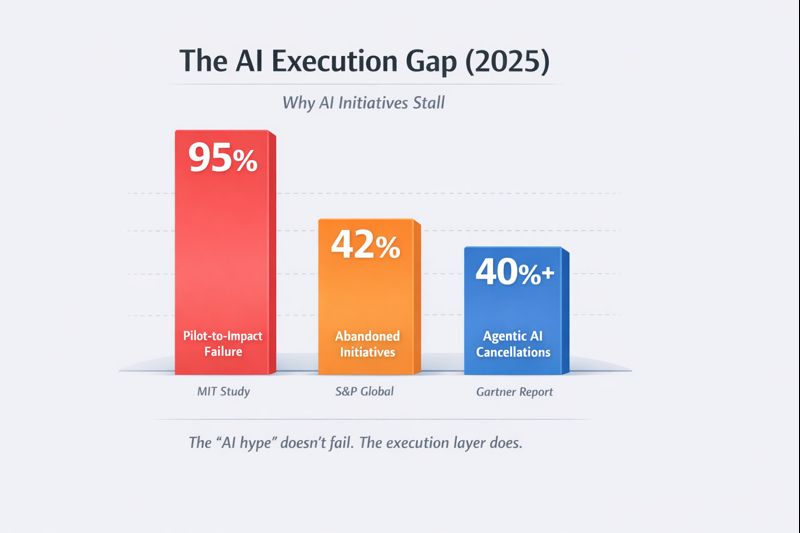
The July 2025 report described preliminary findings from a review of more than 300 publicly disclosed initiatives, interviews with 52 organizations, and surveys of 153 senior leaders. It reported that only 5% of the integrated AI pilots in its analysis were producing millions of dollars in value. That striking result belongs to this study and its definition of measurable P&L impact; it should not be restated as a universal failure rate for all AI projects.
Source: MIT Project NANDA — The GenAI Divide: State of AI in Business 2025 (preliminary report)
Bain: weak foundations constrain scaling
In Bain’s January 2025 survey of 1,263 commercial organizations, roughly one-quarter of sales and marketing AI pilots had failed, roughly one-fifth of pilot-stage use cases were not meeting expectations, and slightly more than half of respondents said their technology and data foundations were inadequate for optimizing AI.
Source: Bain — Parsing How Winners Use AI
S&P Global: more initiatives were abandoned before production
S&P Global’s 2025 survey of 1,006 midlevel and senior technology and business professionals in North America and Europe found that the share of companies abandoning a majority of AI initiatives before production rose from 17% to 42% year over year. Respondents reported, on average, that 46% of projects were scrapped between proof of concept and broad adoption.
Source: S&P Global — Generative AI experiences rapid adoption, but with mixed outcomes
Gartner: a forecast, not an observed failure rate
In June 2025, Gartner forecast that more than 40% of agentic AI projects would be canceled by the end of 2027 because of escalating costs, unclear business value, or inadequate risk controls. This is a forward-looking prediction—not a measurement that 40% had already failed.
Source: Gartner Press Release (2025)The evidence supports a measured takeaway: buying or building an AI capability is not the same as operationalizing it. Production value depends on how the capability is integrated, governed, measured, and maintained.
2) Why AI initiatives stall (the real culprits)
In 2025, the most common failure mode wasn’t “the model didn’t work.” It was strategic execution failure: unclear ownership, no workflow redesign, weak data foundations, and ROI that never got operationalized.
A) “Pilot paralysis” (aka: the sandbox trap)Teams build safe proofs-of-concept that look great in demos — and then die quietly because nobody designed the path to production: security review, monitoring, change management, training, and integration with existing systems.
Related reading: HBR tip on the experimentation trap B) No workflow redesign (AI layered on top of old process)AI doesn’t magically transform a broken operating model. If the workflow stays the same, you just speed up one step while the rest of the process remains the bottleneck — approvals, reviews, exceptions, and handoffs.
C) Data & integration gaps (the “last mile” problem)Many initiatives stalled because they couldn’t reliably access trusted, real-time, domain-specific data — or they couldn’t integrate outputs into systems where action actually happens.
Source: Bain on data strategy & stalled AI D) Unclear ROI + fuzzy accountabilityIf nobody owns the business metric and the workflow change, AI becomes “interesting” but not “funded.” The fastest way to kill a program is to measure it like a science project instead of an operating change.
Supporting perspective: WorkOS — patterns separating winners from abandoned prototypes E) Trust & risk controls were an afterthoughtMany programs paused when legal, security, or compliance asked the obvious questions: Where does the data go? What is logged? How do we prevent hallucinated actions? Who approves changes? Without governance, production stalls.
Related: S&P Global research on mixed results3) A production-oriented playbook
The recommendations below synthesize recurring practices in the cited research. They are practical design principles, not a claim that one recipe guarantees success.
1) Pick a workflow, not a use case“Customer support” is not a plan. “Reduce handle time in Tier-2 incident triage by 30%” is a plan.
2) Embed AI into systems of recordIf the output doesn’t land inside the tools people already use, adoption will be “demo-good” and production-bad.
3) Treat trust as a product requirementHuman-in-the-loop, permissioning, auditability, and safe rollouts are not optional once AI touches operations.
4) Prove ROI through operational metricsTime-to-answer, time-to-remediate, error rate reduction, and automation coverage beat “number of pilots.”
In other words: the winners treated AI as enterprise change — not “feature adoption.”
4) Tanium product examples: workflow integration, not independent ROI proof
Tanium’s product documentation provides examples of AI capabilities connected to endpoint-management and security workflows. These examples show how vendors can place AI inside existing operational surfaces. Public product documentation alone does not establish adoption levels, causal impact, or return on investment, so the discussion below is architectural rather than a success claim.
Tanium Ask Agent — agentic workflows with admin controlAsk Agent is positioned as an agentic AI experience designed to help administrators manage and secure environments through guided workflows. The key design choice is that it’s meant to be operationally safe: embedded in the platform, aligned with permissions, and oriented around actionable steps.
References: • Product documentation • Ask Agent datasheet • Technical deep dive Microsoft Copilot for Security + Tanium — incident triage enrichmentThe Copilot integration matters for a simple reason: it brings endpoint context into a workflow security teams already live inside. That reduces friction, increases credibility, and makes “AI in the SOC” less theoretical.
References: • Microsoft Learn: Tanium plugin • Tanium resource • Integration blog • AI agent integration announcementWhy this design is aligned with production-readiness principles
- Clear workflow intent: not “AI capability,” but operational outcomes (triage, admin workflows, guided actions).
- Embedded delivery: shipped into the tools and surfaces people already use.
- Trust considerations: integration requires configured access and API credentials; actual authorization and audit behavior depends on each customer’s Tanium and Microsoft configuration.
- Ecosystem leverage: partnering where it reduces adoption friction (e.g., the Copilot workflow surface).
| Pattern | What typically stalls elsewhere | What “shipping” looks like |
|---|---|---|
| Workflow integration | Stand-alone bots, disconnected dashboards, no “path to action.” | AI embedded into operational surfaces (admin workflows / SOC tools). |
| Trust & controls | Governance bolted on late; approval, audit, and risk become blockers. | Permission-aligned behavior, auditable operations, safe-by-design patterns. |
| Value clarity | ROI measured as “pilot count” or “cool demos.” | Measured operational outcomes: time saved, triage efficiency, reduction in manual effort. |
5) Where our book directly addresses the stall points
A lot of AI writing focuses on model capability. The more useful conversation is: how do you get AI to survive contact with enterprise reality? That’s the gap our work is designed to close: execution, operating models, governance, and production architecture — not hype.
Pilot → Production pathPractical steps: ownership, controls, monitoring, rollout strategy, and what “done” looks like beyond the demo.
Operating model & governanceHow to make governance implicit in execution, with clear accountability and decision loops.
Architecture that can carry the weightIntegration patterns, data boundaries, observability, and guardrails that keep AI stable in production.
Agentic systems without “agent washing”What actually qualifies as an agent, where autonomy helps, and where humans must stay in control.
Related market signal: Reuters on Gartner’s agentic AI forecastConclusion: 2025 did not prove that AI failed
2025 exposed the real dividing line: the winners don’t “adopt AI.” They operationalize it. They treat AI like an operating model upgrade — with ownership, controls, integration, and metrics — not a feature you bolt onto yesterday’s workflow.
Key takeaway (save this):Most “AI failures” are really the execution tax: no workflow redesign, weak data, fuzzy ROI, missing trust controls, and nowhere for outputs to become action.
If you’re building right now, ask these three questions:- What workflow is changing — and who owns the metric?
- Where does the AI output land — and how does it become action?
- What trust controls exist — permissions, audit, and safe rollouts?
If those answers are vague, you’re not “behind on AI.” You’re about to fund another pilot that never ships.
About the author Kinshuk DuttaWriting on agentic AI, governance, and enterprise systems — with an emphasis on real-world architecture and execution.
Visit kinshukdutta.ai →Fact-check record
Reviewed September 3, 2026. Quantitative claims were checked against the cited source reports. Forecasts are labeled as forecasts, vendor documentation is not treated as independent evidence of ROI, and the preliminary MIT Project NANDA result is presented with its study scope rather than generalized to all AI initiatives.

Historical comments from Datanizant
No public comments on this article
No approved public comments were included in the WordPress export for this article.