Choose the interaction before the transport
THE EVENT JOURNEY · ANIMATED SUMMARY
Master data is rarely the highest-volume data in an enterprise, but each approved change can have unusually wide impact. A customer status, product hierarchy, supplier classification, legal entity, location, or reference-code update may need to reach operational applications, analytics, search, fraud controls, data products, and AI systems. The architectural question is therefore not simply how fast can EBX send data? It is which systems need which change, how soon, with what proof, and how will they recover?
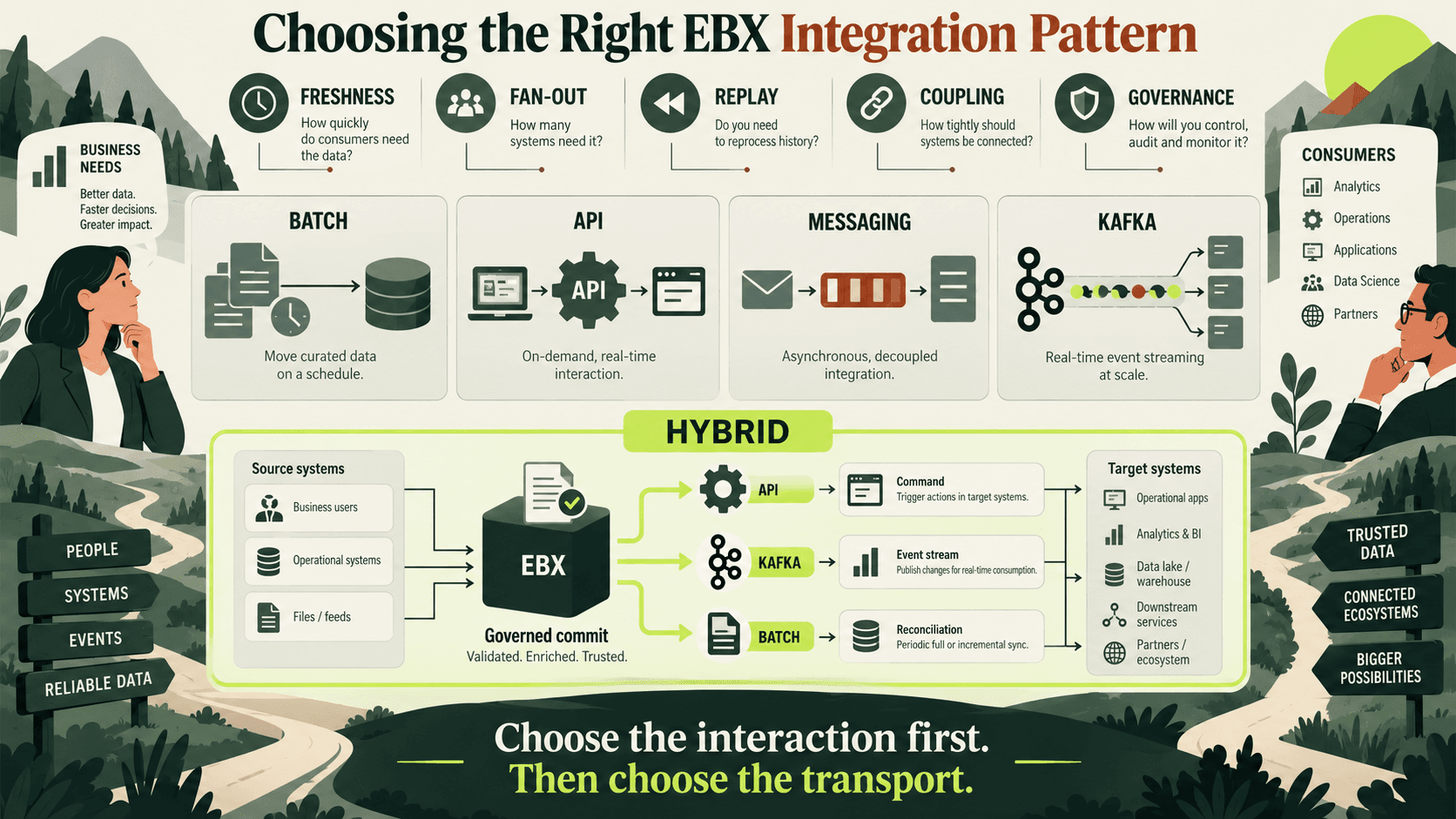
Start with the interaction, not the technology
Batch files, synchronous APIs, work queues, and retained event streams solve different problems. A mature EBX estate normally uses more than one. TIBCO EBX provides built-in REST and SOAP/WSDL data services, XML and CSV import/export, Java APIs, scheduled tasks, and programmatic services. Kafka should complement those boundaries, not erase them.
| Pattern | Use it when | Primary strength | Primary risk |
|---|---|---|---|
| Batch: CSV, XML, SQL or controlled files | Initial load, migration, reconciliation, bulk correction, periodic distribution | Efficient bulk movement with a visible control total | Stale data between runs; partial reruns and file lineage can become manual |
| REST or SOAP/WSDL | A caller needs a command, query, validation, or immediate success/failure response | Clear synchronous contract and direct authorization | Runtime and availability coupling between caller and EBX |
| Queue or enterprise messaging | One worker should perform a command; routing, priority, expiration or request/reply matters | Asynchronous work distribution and broker-directed delivery | Historical replay and adding new subscribers may require extra design |
| Kafka event stream | Many independent consumers need durable change facts, replay and per-entity order | Retained log, independent consumer positions and scalable fan-out | Greater platform, schema, security and operational responsibility |
Why near-real-time integration for master data?
Near-real-time does not mean that every keystroke becomes an event. The useful boundary is usually a governed state transition: a workflow approval, validated record commit, golden-record merge, hierarchy publication, or reference-data release. Publishing after that business boundary lets downstream systems react quickly without turning EBX into a synchronous dependency for every consumer.
Consider an approved supplier-risk classification. A synchronous design might make EBX call procurement, payments, analytics, and notification services in sequence. One slow endpoint extends the EBX transaction or creates a partial-success problem. A nightly export avoids that coupling but leaves the enterprise using stale risk data. An outbox-backed event lets EBX commit its authoritative state once, publish the change reliably, and let each consumer process at its own pace.
Near-real-time distribution is justified when freshness has measurable value: preventing an invalid order, applying an approved hierarchy before the next transaction, removing a restricted supplier, or refreshing a governed AI retrieval index. If the consumer only needs a complete month-end snapshot, batch remains the simpler and often safer answer.
Why not call every consumer through REST?
REST and SOAP are excellent for commands and queries. Use them when the caller needs an immediate answer: retrieve the current customer, validate a code, submit a stewardship request, or invoke a controlled EBX operation. They become awkward as the only distribution mechanism when one EBX change must reach many consumers.
- Availability coupling: the publisher must decide what happens when a consumer is slow or unavailable.
- Fan-out ownership: EBX or an orchestrator must know every destination.
- Recovery: a failed consumer needs a durable retry record and a way to catch up.
- New consumers: adding a subscriber may require republishing history or extracting a new snapshot.
- Transaction ambiguity: an HTTP success does not make the EBX commit and the remote side effect one atomic transaction.
Use an API to ask EBX for current state. Use an event to announce that governed state changed. Many architectures need both.
Why Kafka rather than RabbitMQ or JMS?
JMS—now Jakarta Messaging—is an API specification for Java messaging, not a broker. It defines queue and publish/subscribe concepts implemented by providers. RabbitMQ is a broker supporting queues, exchanges, routing, acknowledgements, quorum queues, and also retained streams. The comparison must therefore be made against the required semantics and the products your organization can operate.
| Requirement | Kafka tends to fit | RabbitMQ/JMS-style messaging tends to fit |
|---|---|---|
| Meaning of the message | A durable fact: customer.approved.v1 | A command or unit of work: recalculate-credit |
| Consumption | Many independent groups maintain their own offsets | One worker consumes from a queue, or each subscriber owns a subscription |
| History | Retention and replay are first-class design concerns | Messages commonly leave a queue after acknowledgement; replay needs deliberate retention or a stream feature |
| Ordering | Stable record keys provide order within a partition | Queue order is affected by multiple consumers, priority and redelivery; broker-specific patterns can preserve it |
| Routing | Usually topic and key based; consumers filter or transform | Rich exchange, binding, selector, priority and expiration patterns |
| Ecosystem | Event streaming, CDC, stream processing, lakehouse and analytics integrations | Enterprise application messaging, application servers, task distribution and request/reply |
Choose Kafka when replay, independently evolving consumers, retained history, per-master-key ordering, rebuilds, and the data-platform ecosystem are central requirements. Choose a queue or JMS provider when the principal requirement is command delivery, work sharing, priority, expiration, request/reply, or alignment with an existing application-server messaging platform. RabbitMQ Streams narrows part of this distinction by providing an append-only, replicated and repeatedly readable log, so a current product-level evaluation is still required.
The recommended EBX hybrid
- Govern in EBX. Publish only after the appropriate validation and workflow boundary.
- Write an outbox record transactionally. Do not make a Kafka call inside the master-data transaction and call the two systems atomic.
- Publish a purpose-built contract. Include event ID, type, schema version, operation, stable master key, occurrence time, source commit identity, and an allowlisted payload.
- Key by business identity. Changes for the same customer, product, supplier, or reference entity normally use the same key.
- Make consumers idempotent. Store the event ID or topic-partition-offset with the destination update.
- Retain periodic reconciliation. Compare EBX authoritative state, outbox delivery, Kafka offsets, consumer ledgers, and downstream business totals.
When Kafka is the wrong answer
- Only one destination exists and it already supports a reliable, idempotent API.
- The requirement is a synchronous command whose caller cannot continue without a response.
- A daily governed snapshot satisfies the freshness objective.
- The organization cannot own topic governance, schemas, access, monitoring, retention, upgrades and incident response.
- Events would expose broad EBX records rather than a minimized, purpose-specific contract.
- No replay, independent consumer, or retained-history requirement exists.
Kafka also does not replace EBX as the system of record, make downstream databases transactionally consistent, or eliminate duplicate delivery. It gives the architecture a durable distribution log; application correctness still comes from contracts, idempotency, reconciliation, security, and tested recovery.
Architecture decision record
Before selecting the transport, write down:
- The business event and the exact EBX approval or commit boundary.
- Required freshness, expected rate, burst, payload size, and growth.
- Every consumer, whether it needs a command or fact, and whether it requires history.
- Ordering unit, delivery expectation, retention, replay and deletion requirements.
- Failure ownership, retry limits, quarantine, RPO, RTO and reconciliation evidence.
- Data classification, field allowlist, schema owner, compatibility policy and access review.
- Why batch, REST/SOAP, queue messaging, and Kafka were accepted or rejected.
- The operating team, platform cost, exit strategy, and proof from a failure rehearsal.
Decision
For EBX master-data change distribution, select Kafka when a committed governed fact must reach multiple independent consumers within a bounded freshness objective and those consumers need durable catch-up or replay. Keep REST/SOAP for commands and current-state queries. Keep batch for initial loads, bulk exchange, and reconciliation. Prefer RabbitMQ or a JMS provider when the workload is primarily task or command messaging and its routing semantics and operational platform are the better fit.
The next article turns this decision into code with the EBX ps-mdm Kafka implementation guide.
Primary references
CHAPTER KNOWLEDGE CHECK · DRAG, DROP, OR TAP

Historical comments from Datanizant
No public comments on this article
No approved public comments were included in the WordPress export for this article.